
Anyone who remembers the December 2007 ice storm in Tulsa knows how long a week without power feels.
Spring storms knock lines down too.
A whole-house standby generator turns that week into a few seconds of dark before the lights come back on. It is also one of the more expensive things you can add to a home, so it pays to understand the cost and get the size right.
When you are ready to price your house specifically, our generator installation team will walk the property with you.
How much does a whole-house generator cost?
National cost guides commonly put a whole-house generator, installed, somewhere between about $5,000 and $25,000. Installation labor alone often runs $1,500 to $5,000 of that. That is a wide range because "whole-house generator" covers everything from a unit that runs your essentials to one that runs every appliance at once.
What moves the price:
Generator size (kilowatts). The biggest factor. Larger units cost more and need a bigger pad and fuel supply.
Fuel type. Natural gas is the easiest if you already have a gas line to the house. Propane works where there is no natural gas, but you will need a tank, and that adds cost.
The transfer switch. An automatic transfer switch senses the outage, disconnects from the utility, and starts the generator. It is required for a standby setup and is part of the install price.
Your electrical panel. Some homes need a panel upgrade or added load management to tie in the generator safely. If your panel is older or full, plan for an electrical panel upgrade conversation.
Distance and site work. How far the generator sits from the gas meter and the panel, whether a concrete pad has to be poured, and local permit requirements.
What size generator do I need for my house?
Start with what you want to keep running, not with a number on a brochure.
Essentials only. Furnace blower, refrigerator, freezer, a few lights and outlets, well pump if you have one, garage door, and phone chargers. Many homes can cover essentials with a smaller air-cooled unit, often in the 10 to 14 kW range.
Most of the house. Add central air on one unit, the water heater if it is electric, the microwave, and the washer. This usually lands in the 18 to 26 kW range.
Everything at once. Multiple air conditioners, electric range, electric dryer, pool equipment, and electric heat. Larger homes with all-electric heat may need a liquid-cooled unit above that, or load management that sheds lower-priority circuits.
Those are rough guides. A proper sizing adds up the running watts of what you want to power and the startup surge of the big motors, mostly air conditioners and well pumps, which pull far more for a second when they kick on. Undersize it and the generator struggles or trips. Oversize it and you paid for capacity you will never use. That calculation is the first thing we do on a generator sizing visit, and it is worth doing before you shop models.
Standby vs. portable
A portable generator costs much less, but you have to wheel it out, fuel it, and run cords or connect it through a properly installed transfer switch or interlock. Never backfeed a house through a dryer outlet. It is dangerous for you and for the line workers trying to restore power. A standby generator does all of this on its own, runs on your gas supply, and tests itself weekly.
Don't skip maintenance
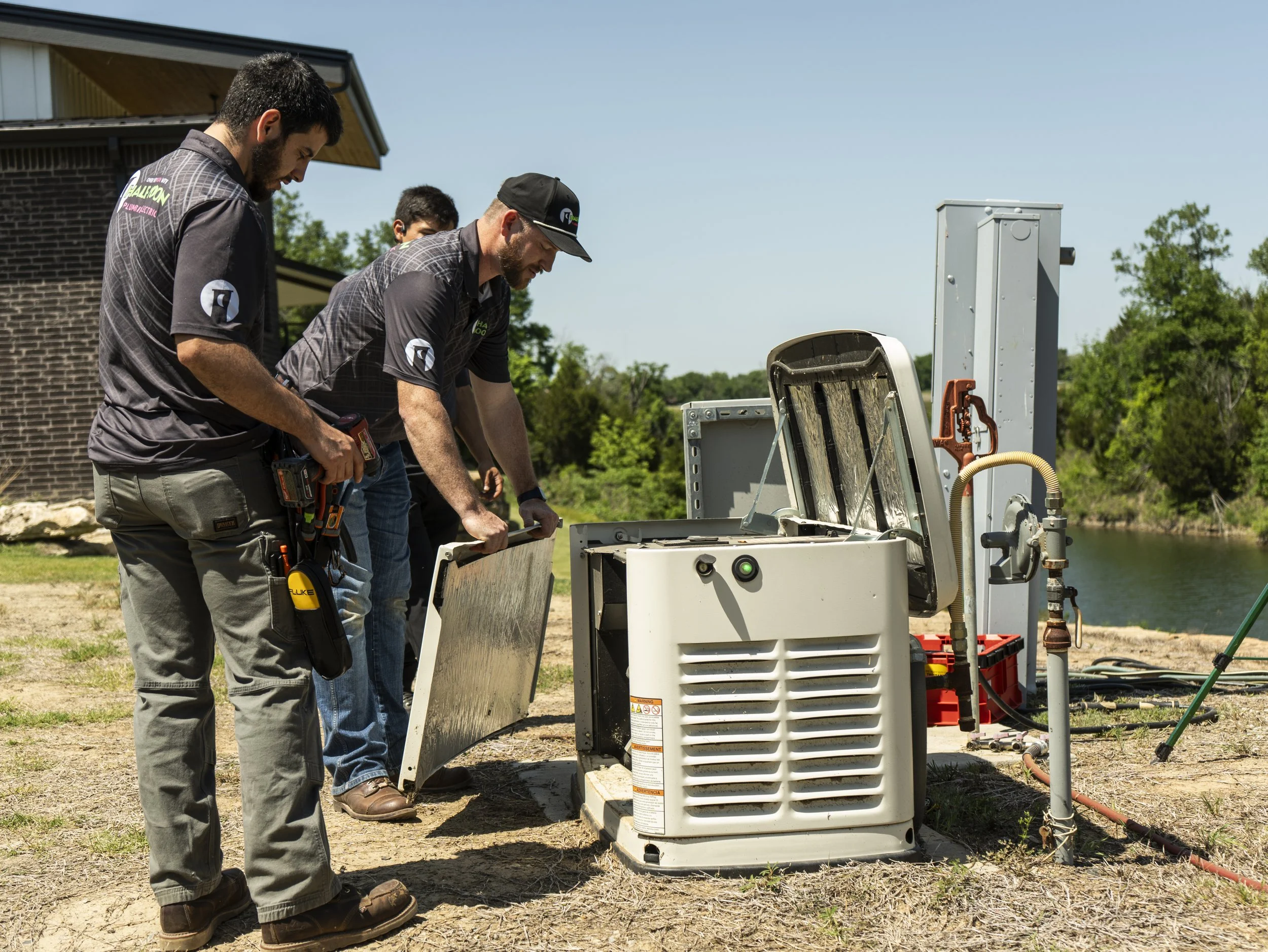
A generator that sits all year and fails to start in an ice storm is the worst kind of surprise. Standby units need oil changes, filter changes, battery checks, and an annual look-over. Our generator repair and maintenance service keeps the one you have ready.
Frequently asked questions
How much does it cost to install a whole-house generator?
National cost guides commonly put the installed total around $5,000 to $25,000, with installation labor often $1,500 to $5,000 of that. Size, fuel, panel work, and site conditions decide where you land.
What size generator will run a whole house?
It depends on what is in the house. Many homes run essentials on a 10 to 14 kW unit and most of the house on 18 to 26 kW. All-electric homes with several AC units can need more. A load calculation is the only way to know.
Is natural gas or propane better for a standby generator?
If you have natural gas service, it is usually simpler and you never have to refill a tank. Propane works well where gas is not available.
How long can a whole-house generator run?
On natural gas, as long as the gas keeps flowing, with breaks for maintenance during a long outage. On propane, as long as the tank lasts.
Does a whole-house generator need a permit?
Typically, yes. The electrical and gas connections are inspected. Your installer should handle the permit.
Ready to stop worrying about the next outage?
Half Moon Plumbing and Electric is a licensed electrical contractor (Lic# 00140295) serving Tulsa, Owasso, Broken Arrow, and the surrounding towns. We will size the generator to your house, explain the options, and give you upfront pricing before anything is installed. See all of our electrical services.
Book Online: schedule a generator sizing visit before storm season.
Call Now: 918-205-2487 to talk it through with our team.