
How a Septic System Works: A Homeowner's Guide

A septic system is a small wastewater treatment plant buried in your yard. Everything that goes down a drain flows to a tank, where solids settle out and bacteria go to work.
The liquid in the middle then flows out to a drain field, where soil finishes the cleaning before the water rejoins the groundwater.
That is the whole idea, and once you can picture it, every maintenance rule about septic service stops sounding arbitrary and starts making sense.
Here is the walkthrough, part by part.
Step 1: Everything leaves the house through one pipe
Sinks, showers, toilets, the washing machine, the dishwasher. It all joins a single main line that runs out of the house and slopes downhill to the tank. There is no pump in a typical setup. Gravity does the work, which is why that line has to keep a steady fall and why a sag or a break in it causes trouble upstream fast.
Step 2: The tank separates what arrives
The tank is a watertight box, usually concrete, typically 1,000 to 1,500 gallons for a house. Inside, gravity sorts what comes in into three layers.
Scum on top. Grease, oils, soap residue. Anything lighter than water floats.
Effluent in the middle. The clear-ish liquid layer. This is the only part meant to leave the tank.
Sludge on the bottom. Solids heavy enough to sink, plus what bacteria cannot digest.
Bacteria living in the tank break down a good portion of the organic material with no oxygen involved. They are effective, but they are not magic. A share of what enters never breaks down, and it stays as sludge. That is why the tank has to be pumped on a schedule. It has nowhere else to put the buildup.
Step 3: Baffles and a filter keep the wrong things from leaving
At the inlet, a baffle or tee slows incoming water so it does not stir up the settled layers. At the outlet, another one reaches below the scum line so only the middle layer can exit.
Many systems also have an effluent filter on the outlet, a screen that catches fine solids before they escape. It is a small part, and it is the reason a lot of drain fields last as long as they do. It also clogs, which is a common and easily fixed cause of backups.
If a baffle cracks or falls off, scum and solids ride straight out to the field. That is the kind of failure nobody notices from inside the house until the field is already damaged, and it is exactly what a technician is checking for during septic tank pumping and cleaning.
Step 4: The drain field does the actual treatment
Effluent leaves the tank and travels to the drain field, sometimes through a distribution box that splits flow evenly across the trenches.
The field is a set of perforated pipes laid in gravel trenches under the yard. Effluent seeps out through the holes, trickles down through the gravel, and enters the soil. Soil is the filter that matters. Bacteria and other organisms living in the top few feet of it consume the remaining contaminants, and the cleaned water eventually rejoins the groundwater.
Two things make this work: the soil must be able to absorb water, and it must have air in it. Both are why we tell people to keep vehicles off the field, keep roof and sump water away from it, and spread laundry across the week instead of dumping a day of flow into it at once.
Aerobic systems: the same job, more equipment
Plenty of Oklahoma properties have aerobic systems rather than conventional ones, often because the soil will not perc well enough for a standard field. Heavy clay is common around here.
An aerobic system adds oxygen to the treatment stage with an air pump, which lets a different set of bacteria break down waste far more thoroughly. The output is clean enough that many of these systems disperse it through spray heads across the lawn rather than underground trenches, usually after a chlorine step.
The tradeoff is moving parts. Air pumps, control panels, alarms, chlorinators, and spray heads all need routine attention, and most aerobic systems in Oklahoma are on a required maintenance contract for that reason. That is what aerobic septic system maintenance covers.
What your system needs from you
Once you can see how it works, the rules are short.
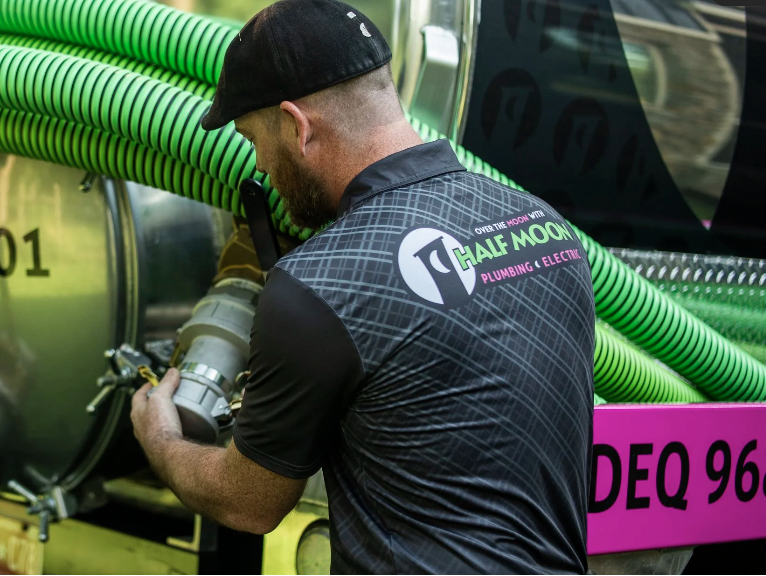
Pump the tank on schedule, generally every three to five years. It is the only way the sludge ever leaves.
Keep solids out. Wipes, paper towels, hygiene products, cat litter, coffee grounds, and grease do not break down. They go straight to sludge or straight to the field.
Watch the water volume. The tank needs time for separation and the field needs time to drain, and a running toilet or a marathon laundry day works against both.
Protect the field. No parking, no sheds, no above-ground pools, no trees close by. Grass over it, and gutters pointed elsewhere. And go easy on harsh chemicals, since bleach and antibacterial cleaners in volume knock down the bacteria doing the work.
That is genuinely most of it. Septic systems are simple, and the ones that fail early almost always failed because of something on that list.
Frequently asked questions
How does a septic system work in simple terms? Wastewater flows to a buried tank where solids settle and bacteria break down what they can. The liquid layer flows out to a drain field, where soil filters and treats it before it reaches the groundwater.
How long does a septic system last? A well-maintained conventional system commonly runs 20 to 30 years or more, with the drain field usually the first part to reach the end of its life. Skipped pumping is the most common reason a system fails early.
Do septic tanks need bacteria added to them? No. Wastewater continuously supplies the bacteria a tank needs. Additives do not remove the inorganic solids that make up sludge, and some can push solids into the drain field.
What is the difference between a septic tank and a drain field? The tank separates and holds solids. The field is where treatment finishes, as effluent filters through the soil. The tank can be pumped and reused; a field that has sealed off has to be replaced.
How do I know if I have an aerobic or conventional system? Aerobic systems have visible equipment: a control panel, an audible or visual alarm, and often spray heads in the lawn. Conventional systems have none of that. County records and your original permit will confirm it.
Questions about your own system?
If you have just bought a place with a septic system, or you have lived with one for years without ever seeing inside the lid, an inspection is a good way to learn what you actually have. Half Moon Plumbing and Electric installs, services, and repairs septic systems across the Tulsa area. Start on our septic services page.
Call Now: 918-205-2487 Book Online: schedule a septic inspection in a couple of clicks.